

 25 min read
Ask ChatGPT to name the best CRM for a growing B2B company and it will answer with confidence: a short list, a reason for each pick, maybe a source or two. Ask Perplexity the same question and you might get a different list, built from a different kind of evidence. Ask Gemini or Claude and the pattern repeats: confident answers, plausible reasoning, and just enough variation between platforms to raise an obvious question. What actually decides which brands show up?
We wanted to find out, so we ran the same set of commercial research prompts across four AI assistants (ChatGPT, Perplexity, Claude, and Gemini) and compared what came back. This is not a claim that we reverse-engineered how any of these systems rank brands internally. It's an observed-output study: a record of what these tools said, on one day, in one location, in response to one set of prompts. A brand appearing in an answer is not proof that it is objectively the best provider, and a citation is not automatically an endorsement. With that caveat in place, the patterns that did emerge are worth paying attention to, because they point to something more specific than "do good SEO."
How we ran the experiment
We wrote one consistent prompt template and used it to ask each assistant about eight common B2B buying categories: digital PR agencies, guest post marketplaces, B2B SaaS link building, email marketing, CRM software, project management tools, AI marketing tools, and media monitoring platforms. Each prompt asked for a short, ordered list of named companies, a brief reason for each, and sources where available. We then asked three follow-up prompts in every session: why those brands specifically, what a lesser-known but objectively competitive company would need to do to be recommended, and what practical steps a company can take to be discovered, understood, and trusted.
Methodology box
- Platforms tested: ChatGPT, Perplexity, Claude, and Gemini, all with web search or search grounding enabled where available.
- Prompt type: eight identical commercial-recommendation prompts per platform, followed by three reflection prompts probing the assistant's own reasoning.
- What was compared: which brands appeared, in what order, with what type of supporting evidence, and how each assistant described its own selection process.
- Limitations: this was a single-day, single-location snapshot, not a longitudinal or multi-region study. Prompts within each platform were run in one continuous session rather than separate fresh chats, so earlier answers could have shaped later ones.
What the AI answers had in common
The first thing that stood out was how often the same names came up, especially in the more established categories. In guest post marketplaces, WhitePress, Collaborator (also listed as Collaborator.pro), PRNEWS.IO, and Getfluence appeared across all four assistants in some order. In B2B SaaS link building, uSERP, Siege Media, and Skale showed up on every platform's list. CRM answers converged on HubSpot, Salesforce, Zoho CRM, and Pipedrive almost everywhere, and project management answers leaned heavily on Asana, monday.com, ClickUp, and Trello regardless of which assistant was asked. In this study, that kind of convergence was strongest in categories with a small number of well-known, well-reviewed vendors, and weaker in newer or more fragmented categories like AI marketing tools, where the lists diverged more between platforms.
The second pattern was in how each assistant explained its own reasoning, and the differences were genuinely interesting. ChatGPT, in this round, said its picks leaned on brand-owned pages and case studies, and it explicitly flagged that familiarity with a brand name going into a search likely shaped which candidates it considered at all. Perplexity described actively cross-checking G2, Capterra, and Trustpilot, and said it downweighted or excluded a name (Copy.ai) when review scores disagreed sharply between platforms. Claude emphasized convergence across unrelated, competing publishers as its strongest filter, and was unusually direct about its own limits: "I did not test any product, hold an account with any vendor, speak to any customer, or access private data," it said of its own process. Gemini leaned more on comparison guides and roundup-style content, and in one answer offered a specific, precise-sounding statistic (that brands with active third-party trust signals are cited in 75% of AI answers versus 1% for those without) that came with no traceable source. We could not verify that number anywhere and are not repeating it as fact; we're flagging it because it's a useful example of the exact problem this piece is about: treating an AI's own explanation of its process as more solid than it is.
A third, more procedural pattern: several assistants said, unprompted, that a citation in their answer is not the same thing as a verified recommendation. Perplexity put it plainly, describing discoverability and recommendability as "two different, separately-gated problems." ChatGPT made a similar distinction between being crawlable, being cited, and being trusted. That distinction became the organizing idea for the rest of this piece.
The three layers of AI recommendation visibility
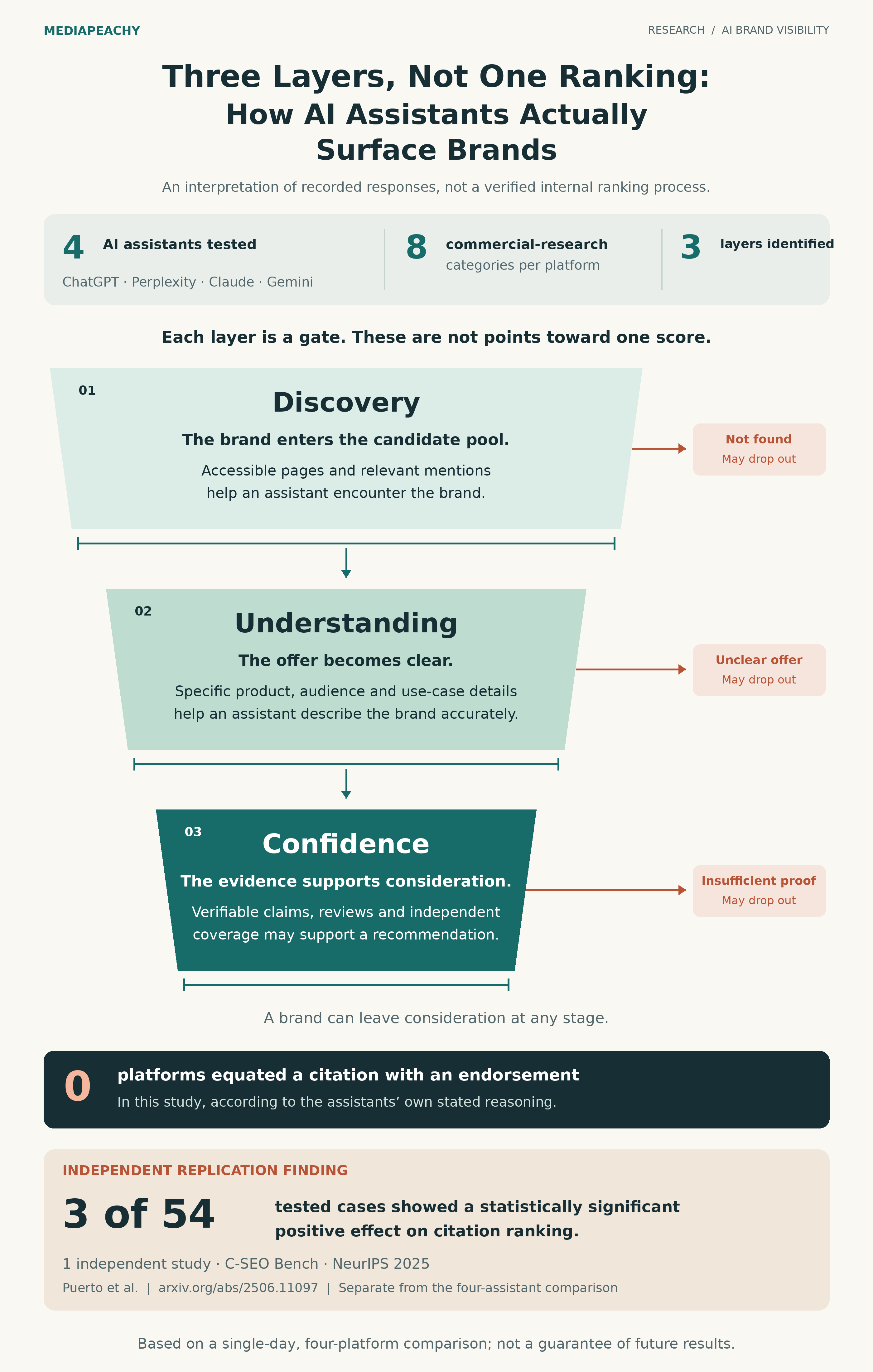
Across the recorded responses, what determined whether a brand showed up, and how it was described, tended to split into three separate layers. None of them guarantees the others.
| Layer | What it means | Evidence a brand should publish or earn | Common mistake |
| Discovery | Whether an AI system's crawlers and search tools can find and retrieve the page at all | Crawlable pages (no blanket robots.txt or CDN blocks on relevant bots), clear internal linking, core text available in HTML rather than locked behind JavaScript rendering, listings on review or comparison platforms the assistant actually searches | Assuming that blocking an AI training crawler (like GPTBot) also blocks the same company's search crawler (like OAI-SearchBot); the two are controlled separately, per OpenAI's crawler documentation |
| Understanding | Whether the assistant can tell what the company does, who it's for, and how it differs from competitors | A clear, specific business description; consistent facts (pricing, specialties, client types) repeated the same way across the company's own site and third-party sources; structured data that matches the visible page content | Publishing many near-duplicate pages aimed at slightly different keywords, which Google explicitly treats as an attempt to manipulate generative AI responses under its spam policies |
| Confidence | Whether there's enough independent evidence to make recommending the brand defensible | Named case studies with real client permission, original research with a stated methodology and date, independent reviews that agree across more than one platform, transparent pricing and named leadership | Mistaking a large volume of self-published "best of" content, or a directory placement the brand paid for, for independent validation |
No single layer is sufficient on its own. A page can be perfectly crawlable and still never get recommended because there's no independent evidence behind it. A brand can have glowing case studies and still be invisible if its pages are locked behind scripts an assistant's search crawler can't render.
What brands can do now
Given all three layers matter, the realistic goal is reducing friction at each stage rather than chasing a specific ranking. A prioritized starting point:
- Confirm robots.txt and CDN/firewall rules don't block bots used for AI search retrieval, as distinct from bots used for model training.
- Keep core product, pricing, and use-case information in plain HTML text, not only inside JavaScript widgets or PDFs.
- Write one clear paragraph describing what the company does and who it serves, and keep it consistent across the company site, LinkedIn, review profiles, and press mentions.
- Audit third-party listings (G2, Capterra, Trustpilot, Clutch) for outdated pricing, fragmented profiles under different names, or unanswered negative reviews.
- Publish case studies naming a real client (with permission), a specific timeframe, and a measurable outcome, rather than vague "results may vary" claims.
- Seek independent coverage or comparison mentions on sites the brand doesn't own, rather than relying solely on owned "best of" content.
- Where original research is published, include methodology, sample size, and date, and disclose limitations rather than presenting numbers as settled fact.
- Use structured data (Organization, Product, FAQ schema) that accurately reflects what's already on the page, not aspirational claims.
- Track how often the brand is mentioned across different assistants and dates as a visibility metric, separate from any assumption that visibility equals endorsement.
- Avoid publishing large volumes of near-identical landing pages for minor keyword variations; this is flagged as manipulative under Google's generative AI content guidance.
A specific warning worth repeating on its own: thin, duplicate, or template-stuffed pages built to catch more search variations are exactly the pattern Google has said it treats as an attempt to game generative AI responses, and it falls under the same site reputation abuse and spam enforcement that applies to traditional search manipulation. Producing more content is not automatically safer than producing less, more specific content.
The signals marketers tend to overrate
A few things showed up in this study, or in the fact-checking behind it, that are worth naming directly because they're easy to overrate.
Raw search visibility and content volume are not reliable proxies for AI recommendation. Perplexity said this almost word for word: a polished site, a large volume of blog or listicle mentions, and a high search ranking do not reliably correlate with the kind of evidence that moved its own recommendations. In its answers, high self-published visibility sometimes triggered more scrutiny rather than less.
Review scores in isolation can mislead, and disagreement between platforms is itself a signal worth watching. Claude specifically excluded a well-known AI writing tool from one of its lists because its G2 score and its Trustpilot score told two different stories, and it treated that gap as disqualifying rather than picking whichever number looked better.
The much-cited claim that adding citations, quotations, and statistics to a page boosts AI visibility by "30 to 40 percent" needs more context than it usually gets. That figure traces back to a real, peer-reviewed paper from Princeton, IIT Delhi, and collaborators, published at KDD 2024, which found those content changes improved specific visibility metrics on a simulated engine built for the study (Aggarwal et al., "GEO: Generative Engine Optimization," arXiv:2311.09735). A later, independent replication at NeurIPS 2025 tested the same and additional methods under more realistic conditions and found the opposite in most cases: of 54 method-domain-model combinations tested, only 3 showed a statistically significant positive effect on citation ranking, and none came from the original paper's methods; some original tactics measurably hurt ranking in most settings tested (Puerto et al., "C-SEO Bench," arXiv:2506.11097). The honest takeaway isn't "citations don't matter." It's that a specific percentage lift, repeated confidently across marketing blogs, hasn't held up under independent testing, and vendors quoting it as a guarantee are overstating what the research supports.
Finally, an AI system's own explanation of why it chose a brand is not a complete account of its process. Every assistant in this study said, in some form, that its stated reasoning was a summary rather than a full technical record. That's worth remembering for anyone reading AI-generated brand recommendations, including us.
What this means for SEO and digital PR
The pattern across all four assistants points to something specific: AI search visibility isn't a new discipline bolted onto old SEO, and it isn't solved by a single technical fix or schema tag. It behaves like an extension of the same fundamentals search marketers already know, applied to a retrieval and summarization system instead of a ranked list of blue links.
Expert perspective
Danny Sullivan, Google's Search Liaison and a director within Google Search, made a version of this point directly at his WordCamp US keynote. "Good SEO is good GEO," he said, adding that generative engine optimization "is the same core work SEOs have always done: creating unique, valuable content for people and providing a great page experience." He was direct about not wanting people to panic over the terminology: "The basic things have not changed... What you've been doing for search engines generally, and you may have thought of as SEO, is still perfectly fine" (reported by Danny Goodwin, Search Engine Land, September 2, 2025).
That framing lines up with what showed up in our own comparison: the brands that recurred across multiple assistants tended to have clear, consistent, well-documented information available in more than one independent place, not a single clever AI-specific trick. For digital PR specifically, that means earned coverage and independent comparison mentions still function as trust signals an assistant can find and repeat, in the same way they've always functioned as trust signals for human researchers and traditional search rankings.
The bottom line
Across four AI assistants asked the same commercial questions, the brands that came up most consistently were rarely the ones with the most content. They were the ones that were easy to find, easy to describe accurately in one paragraph, and backed by evidence the assistant could locate somewhere other than the brand's own website. None of that guarantees a mention in any future AI answer, and none of it should be read as a verdict on whether any specific brand is actually the best choice in its category. What this comparison does show is that discovery, clear description, and independently checkable evidence are three separate jobs, and skipping one doesn't get compensated for by doing more of another.
FAQ
Does appearing in an AI-generated answer mean a brand is endorsed by that AI?
No. Every assistant in this study described citation and inclusion as a function of what it could find and retrieve, not a certification of quality. A brand can appear because it was discoverable and well-described, without that reflecting an independent quality judgment.
Can a business pay to be recommended by ChatGPT, Perplexity, Claude, or Gemini?
Not directly, based on what these assistants described of their own process here. Several said they downweighted or excluded self-promotional or paid-placement content. Sponsored content and paid directory listings are not the same as independent validation.
Is generative engine optimization (GEO) a proven, separate discipline from SEO?
It's an emerging area of study with mixed early evidence. A widely cited paper found specific content changes improved visibility on a simulated system, but an independent replication under different conditions did not confirm most effects. Treat specific percentage claims with caution.
Do I need special AI-specific schema markup or an AI-only content file?
No. Google's guidance for AI features states there are no additional technical requirements beyond standard SEO fundamentals, and structured data should simply match what's visibly on the page.
Why didn't this study include Microsoft Copilot?
Copilot was part of the original research plan, but this completed round covered four assistants: ChatGPT, Perplexity, Claude, and Gemini. That limitation is disclosed here rather than glossed over.
Will the same brands come up if I ask these questions myself?
Possibly not the same ones. Results like these can vary by date, location, account history, model version, and prompt phrasing. This was a single-day, single-location snapshot, not a guarantee of stable rankings over time.